How to Integrate AI Chatbots into Custom ERP Systems: A Comprehensive Guide
The Evolution of the Silent ERP
For decades, Enterprise Resource Planning (ERP) systems have been the backbone of business operations—silent, robust, data-rich repositories. But they were always reactive. To get information, you had to query, generate reports, or navigate complex menus.
Today, the paradigm is shifting. Businesses are asking: “How can my ERP system talk to me?”
The answer is integrating conversational AI Chatbots directly into your custom ERP architecture.
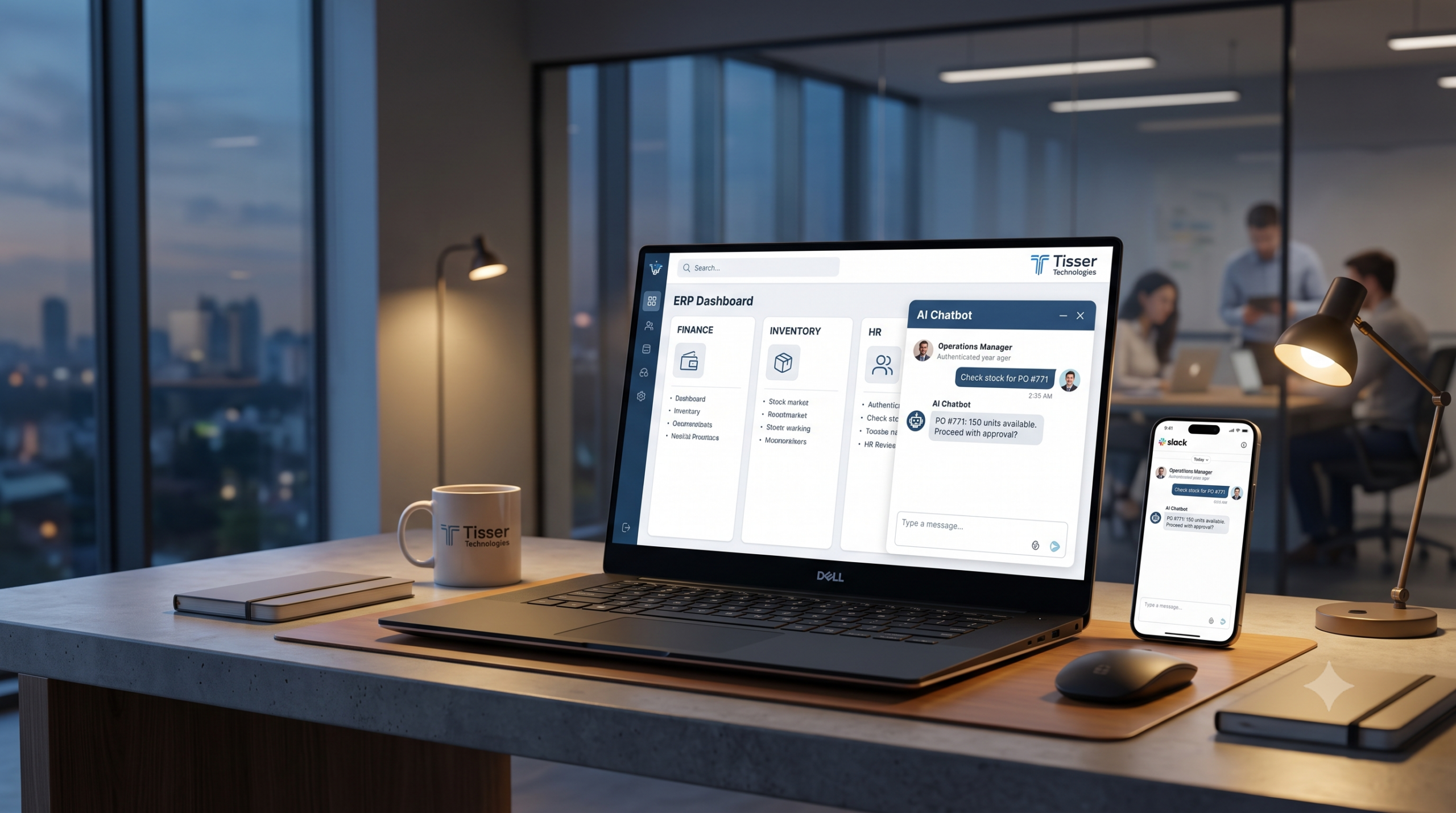
Imagine querying inventory levels, approving purchase orders, or analyzing production bottlenecks—all through a natural language conversation on WhatsApp, Slack, or a dedicated web portal. This is no longer future-tech; it is a competitive necessity for modern, data-driven organizations.
Here is your comprehensive strategic guide on how to integrate AI Chatbots into your custom ERP.
What does “AI ERP Integration” Actually Mean?
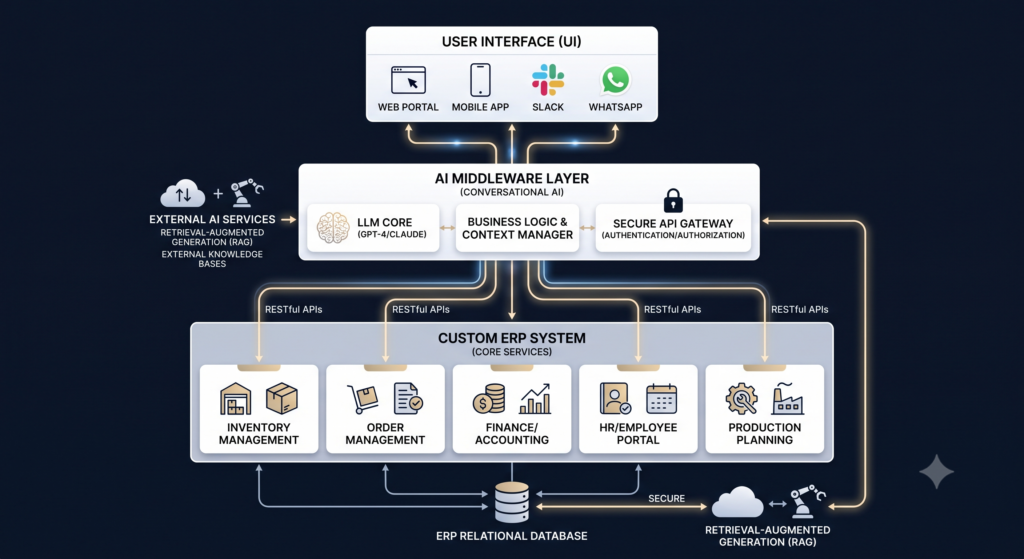
At its core, ERP integration isn’t just about embedding a generic chatbot on a webpage. It means creating a secure, real-time middleware layer that connects an Intelligent Assistant (powered by Large Language Models or LLMs like GPT-4, Claude, or Llama) to your ERP’s relational databases, APIs, and business logic.
Unlike static chatbots, an AI-powered ERP assistant is context-aware. It understands your role (e.g., procurement vs. sales), accesses real-time data securely, and can execute actions, not just answer questions.
The Architecture: High-Level AI-ERP Integration Flow
To understand how the integration works, let’s visualize the data flow:
Phase 1: Planning and Security (The Foundation)
Integration doesn’t start with code; it starts with policy. ERP data is sensitive. Security is paramount.
1. Define Authentication and Authorization (Crucial)
You cannot integrate a chatbot that can access anyone’s data.
- Authentication (Who are you?): Use established standards like OAuth 2.0 or OpenID Connect. When a user interacts with the chatbot, they must first log in using their existing ERP credentials.
- Authorization (What can you access?): The middleware must inherit the Role-Based Access Control (RBAC) defined in the custom ERP. If an HR assistant is queried by a sales manager about payroll, it must gracefully deny access based on that user’s ERP role, regardless of how smart the LLM is.
2. Choose Your AI Model Strategy
- Proprietary/Cloud Models (e.g., GPT-4, Claude): Easier to deploy, highly capable, but requires sending data to a third party (often unacceptable for sensitive ERP data). RAG is essential here.
- Self-Hosted/Open-Source Models (e.g., Llama 3, Mixtral, Qwen): Maximum data privacy (runs on your infrastructure or private cloud). Requires significant MLOps expertise and GPU hardware, but offers ultimate control.
Phase 2: Implementation (Building the Connection)
3. Develop the Middleware / Orchestration Layer
This is the core of the integration. This application handles the conversation state, security, and API calls.
- It receives user input from the front end.
- It authenticates the user session.
- It manages context (remembering the previous question).
- It determines when to call an ERP API vs. when to use the LLM for generation.
4. The Magic Key: Retrieval-Augmented Generation (RAG)
Generic AI models do not know your internal ERP data. RAG is the architecture that provides this specific knowledge without retraining the model.
- Ingestion: Periodically or in real-time, relevant metadata from your ERP (e.g., product catalogs, employee handbooks, schema definitions) is vectorized and stored in a specialized Vector Database (e.g., Pinecone, Weaviate, Qdrant).
- Retrieval: When a user asks “What is the status of PO #554?”, the middleware first searches the vector database to find the semantic structure of POs.
- Generation: It takes the metadata structure and the user’s request, forms a precisely structured prompt, and queries the live ERP SQL/REST API to retrieve the specific data (status of PO #554). It then passes this combined information (internal policy + live data) back to the LLM to generate a natural language response.
Use Cases: The Transformative Power of an Integrated ERP
Integrated AI Chatbots transform your ERP from a passive database into an active intelligence partner across departments:
- Finance & Procurement: Instantly query inventory levels by voice, receive predictive stock alerts, and approve large purchase orders via mobile (WhatsApp/Slack) with proper authentication.
- HR & Employee Portal: Employees can apply for leave, check internal policies, or download payslips via the chatbot, reducing repetitive HR inquiries.
- Production & Operations: Supervisors can log shift anomalies or query real-time production metrics using natural language on the factory floor.
- Sales & Customer Service: Sales teams can instantly check client order status or inventory availability in real-time while on call, increasing responsiveness.
Phase 3: Testing and Deployment
5. Rigorous Testing
- Security Audits: Intentionally try to access unauthorized data to ensure RBAC is inherited correctly.
- Latency Testing: Ensure the RAG process (Retrieval, API call, LLM generation) provides a smooth, conversational experience, not a disjointed laggy one.
- UAT (User Acceptance Testing): Gather feedback from actual department users to ensure the AI speaks their functional language.
Summary: The Strategic Advantage of Intelligent ERP
Integrating conversational AI into your custom ERP architecture is a transformative decision. It moves your data from being “stored” to being “active” and accessible.
It creates a more agile, responsive workforce that can query enterprise knowledge base and execute operations from anywhere, instantly. The result is a dramatic increase in operational efficiency, faster decision-making cycles, and a sustainable competitive edge.
Ready to Talk to Your ERP?
At Tisser Technologies, we specialize in modern, custom ERP development and sophisticated AI integrations. Whether you have an existing custom ERP that needs intelligence or you are planning a comprehensive digital transformation, our team of solution architects can design and implement a secure, scalable AI chatbot integration tailored to your precise operational needs.
👉 [CONTACT TISSER TECHNOLOGIES TODAY FOR YOUR FREE ERP AI AUDIT]
Loading next article...